
Pills, Mini Pills and Contraceptive Injections
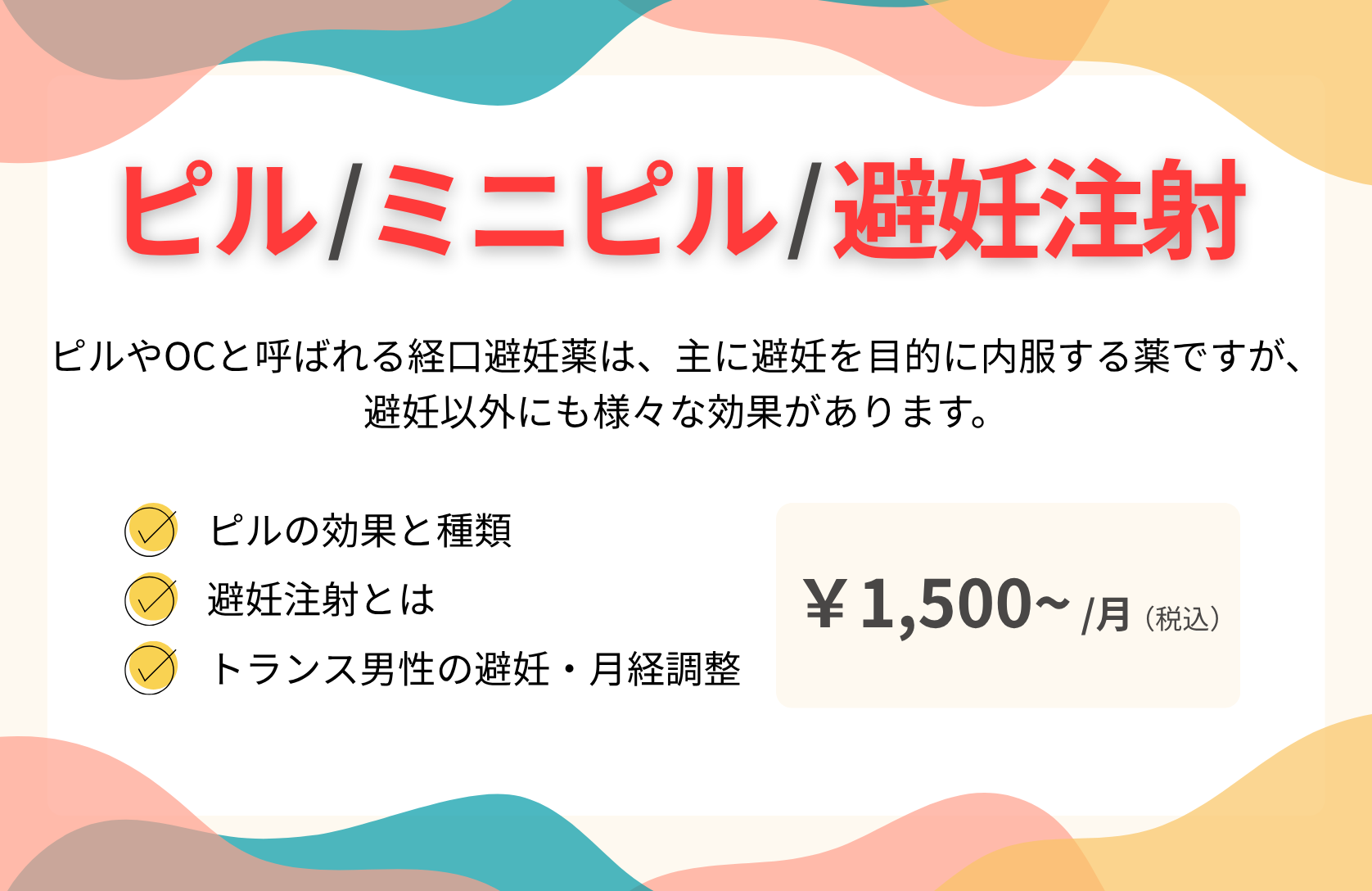
We propose contraception and menstrual management options suited to your goals, including low-dose pills, medium-dose pills and mini pills (progestin-only), as well as contraceptive injections (Depo-Provera).
Transgender men and non-binary individuals can also receive specialized consultations on contraception and menstrual management tailored to their affirmed gender and circumstances.
Please select the section to jump to.
Note that the prices indicated in this page are all inclusive of tax.
For those living far away, we offer telephone consultations and a delivery service.
Effects and Types of Pills
What is the Pill?
Oral contraceptives (OC: Oral Contraceptive), commonly called pills, are medication taken mainly for contraception, but they also have a variety of effects beyond contraception.
Incorrect ways of taking them, or medication obtained through personal import, may increase side effects or fail to deliver the expected effects, so we recommend understanding oral contraceptives well and purchasing them at a medical institution.
– Those who want contraception
– Those who want to shift their period
– Those who want to relieve symptoms of premenstrual syndrome (PMS)
– Those who want to improve/reduce menstrual pain or irregular periods
Effects of the Pill
By taking 1 tablet at the same time every day, the pill offers women a variety of benefits beyond contraception.
The probability of pregnancy is generally said to be 9 percent, but with no missed doses of the pill the probability of pregnancy is 0.1 percent, providing a high rate of contraception.
Starting to take it after contraception has already failed cannot be expected to be effective, so if contraception has failed you need to consider taking a morning-after pill (emergency contraception).
You can shift your period for travel, events, exams and the like.
Periods come regularly on an approximately 28-day cycle.
Menstrual flow decreases and menstrual pain is relieved.
By controlling fluctuations in hormone secretion, it relieves premenstrual irritability, breast tenderness, swelling of the limbs and face, etc.
Types of Pills
Pills (oral medication) are broadly divided into “low-dose pills (combined pills)”, which contain estrogen, and “mini pills (progestin-only)”, which do not contain estrogen. “Medium-dose pills” are sometimes used for purposes such as shifting periods.
In addition, progestin-only contraception also includes the “contraceptive injection (Depo-Provera)”, which is given not orally but by injection once every 3 months.
Low-dose pill: An oral medication containing estrogen plus progestin, which in addition to contraception is sometimes used to improve menstrual pain and PMS (premenstrual syndrome) and to regulate the cycle.
Medium-dose pill: Medication most often used only for the period required, mainly for scheduling purposes such as shifting periods (bringing the date of a period forward or delaying it) (it is not taken long-term).
Mini pill: An oral medication that does not contain estrogen, which can be an option even for those who are breastfeeding or who are concerned about the risk of thrombosis. Bleeding patterns, such as breakthrough bleeding, can readily become irregular.
Contraceptive injection (Depo-Provera): A progestin-only injection, a method in which a contraceptive effect can be expected with administration once every 3 months.
Low-Dose Pill
What is the Low-Dose Pill?
The low-dose pill is medication (oral) containing estrogen plus progestin, which in addition to contraception is also used to improve menstrual pain and PMS (premenstrual syndrome) and to regulate the cycle.
Types of Low-Dose Pills
There are several types of low-dose pills, differing slightly in how readily side effects appear, their effect on acne and so on.
If you would like a prescription or are unsure, please feel free to tell a doctor or nurse at your consultation.
| Ravelfeuille (Triquilar Generic) | Favoir (Marvelon Generic) |
|
|---|---|---|
| Phasic type | Triphasic | Monophasic |
| Characteristics | The amount of female hormone contained in 1 tablet changes slightly every few days. The hormone amount is divided into 3 stages, bringing it closer to the hormone balance of the menstrual cycle, so side effects are less likely to appear. | The amount of female hormone contained in 1 tablet is entirely constant. Every tablet contains a constant amount of hormone, and it has little androgenic action, so it is effective for acne and hirsutism. |
| Recommended for | Those prone to breakthrough bleeding Those prone to breakthrough bleeding while taking the pill | Those who often shift their period Those who do not want their period to come Those who want to keep taking it continuously Those troubled by acne or PMS |
Side Effects and Precautions
With pills containing estrogen (low-dose pills, medium-dose pills, etc.), the risk of venous thromboembolism (VTE: Venous Thromboembolism) as a serious side effect is approximately 2 to 3 times higher than when not taking them.
However, the frequency is not high; as a guide, it is reported to be around 4 to 5/10,000 people per year among non-users, and higher than that with combined pill use.
Those who smoke (especially those aged 35 and over), those who are breastfeeding, those with a history of thrombosis, those with migraine with aura, those with severe hypertension or cardiovascular disease and others may find low-dose pills unsuitable, so please consult a doctor at your visit.
We will propose options suited to your goals, such as “mini pills”, which do not contain estrogen, or the “contraceptive injection (Depo-Provera)”.
To enable safe use of the pill, we have prepared a blood-sampling package that evaluates thrombosis and other conditions.
Test contents: AST, ALT, triglycerides, LDL cholesterol, PT, APTT, D-dimer (2,500 JPY)
*For those using pills or mini pills, we recommend blood sampling once a year.
Medium-Dose Pill
What is the Medium-Dose Pill?
The medium-dose pill is medication most often used when you want to adjust your period temporarily, such as for shifting a period.
Because it contains more hormone than low-dose pills and mini pills, it is known that side effects appear more readily the longer it is taken.
In particular, care is needed as the risk of thrombosis and the like is higher than with low-dose pills and mini pills.
As a rule, we recommend short-term use.
Methods of Shifting a Period
There are 2 methods of shifting a period, and either method is possible by using medium-dose pills.
| Delaying a period | Bringing a period forward | |
|---|---|---|
| When to start taking | From 5 days before the expected date of the period you want to adjust | At the point the period one cycle before the one you want to bring forward begins (at the latest, within day 5 of the period) |
| When to stop taking | Until the day you want to avoid your period | Any time after taking it for 7 to 14 days or more |
| When periods resume | 2 to 3 days after stopping | |
| Advantages | Shifting the period is possible almost reliably Can accommodate sudden plans | No need to take the pill during the event |
| Disadvantages | You need to keep taking the pill during the event as well | You need to start taking it according to plan The failure rate for shifting the period is higher than with the method of delaying the period |
If you are taking low-dose pills, you may be able to shift your period by adjusting the pill-free (placebo) interval or by taking them continuously.
With mini pills, bleeding patterns readily become irregular, and adjustment for the purpose of shifting a period is generally considered difficult.
If you would like to shift your period using the pill you are currently taking, please feel free to consult a doctor.
Side Effects and Precautions
Because medium-dose pills have a larger amount of estrogen than low-dose pills, side effects such as nausea, headache and breast tenderness tend to appear more readily.
Also, with pills containing estrogen, care is needed regarding venous thromboembolism (VTE: Venous Thromboembolism), and since the risk may generally be higher with medium-dose than with low-dose, we prescribe them for use only for the period required, such as for shifting a period, after checking background risks such as smoking and medical history.
Mini Pill
What is the Mini Pill?
Low-dose pills contain estrogen and progestin combined together, whereas the mini pill is a pill that contains only progestin.
Conventional low-dose pills are said to carry a risk of thrombus formation due to side effects of the estrogen, so low-dose pills are not recommended for those at risk of thrombosis, smokers, those with hypertension and older individuals.
However, the mini pill, which acts with progestin only, can also be taken by the people listed above.
If there are no missed doses and it can be taken at the same time every day, a contraceptive effect roughly equivalent to that of low-dose pills is obtained.
Differences Between Mini Pills and Low-Dose Pills
Since the mini pill is medication that does not contain estrogen, it is a contraceptive method that is easy to choose even for those who are breastfeeding or who are worried about thrombosis.
On the other hand, low-dose pills can be expected not only to provide contraception but also to ease menstrual pain and PMS and to regulate the rhythm of periods.
| Comparison item | Mini pill | Low-dose pill |
|---|---|---|
| Hormones contained | Progestin only | Estrogen plus progestin |
| Contraceptive effect | If taken correctly, at a level equivalent to low-dose pills | High contraceptive effect |
| Missed doses | The "allowable window for a missed dose" is shorter | Comparatively more leeway |
| Menstrual changes | Breakthrough bleeding appears readily | Regular withdrawal bleeding is likely The cycle is easy to control |
| Advantages | Can be used by those who cannot use estrogen, those at high risk of thrombosis and those who are breastfeeding | Contraception plus improvement of dysmenorrhea Relief of PMS Easy to adjust the days of your period Some medications can also be expected to improve acne/oily skin |
| Disadvantages | May not suit you if breakthrough bleeding, depression, worsening acne and the like are severe | Careful evaluation is needed for smokers (especially those aged 35 and over), obesity, migraine (with aura), a history of thrombosis, severe heart disease, liver disease and the like |
Differences Between Mini Pill Products
We handle 2 types: Azalia (Cerazette generic), an imported medication, and the newly released Slinda.
Azalia and Slinda are both mini pills and there is no major difference between them, but because their components differ, the side effects that appear may differ.
Please refer to the table below and discuss with a doctor which product suits you.
| Comparison item | Slinda | Azalia |
|---|---|---|
| Component | Drospirenone | Desogestrel |
| Content | White tablets drospirenone 4㎎ Pale yellow tablets no active ingredient | Desogestrel 75μg |
| Method of Use | 28 days of continuous dosing (with placebo) Taken once a day at a set time | 28 days of continuous dosing Taken once a day at a set time |
| Manufacture | Made in Japan | Made overseas |
| Contraceptive effect | High | High |
| Quitting smoking/breastfeeding | Possible | Possible |
| Characteristics | Covered by Japan's medication compensation system The medication has a long half-life, so breakthrough bleeding is less likely to occur | Because there is no placebo, there is no bleeding at a set time during dosing Breakthrough bleeding can occur |
How to Switch from Low-Dose Pills to Mini Pills
It is also possible to switch from low-dose pills to mini pills.
To switch, after you have finished taking all of the tablets containing the active ingredient of the low-dose pill you were taking before, in the prescribed manner (for those taking a 28-day cycle product, after finishing up to day 21), start taking this medication from the following day.
Note that if you start taking it late, the contraceptive effect may decrease.
Side Effects and Precautions
The following side effects have been reported with mini pills. Breakthrough bleeding in particular is a commonly seen side effect.
Even if bleeding appears, in principle please continue taking it as it is.
If the amount of bleeding is heavy or it continues for many days, please consult a doctor, and we will address how you take it and the choice of product.
If missed doses continue for 2 days or more, please use another contraceptive method, such as condoms, in combination.
Breakthrough bleeding, lower abdominal pain, menstrual abnormalities (scanty periods, heavy periods, irregular periods, etc.), headache, abdominal pain
Contraceptive Injection (Depo-Provera)
What is Depo-Provera (Contraceptive Injection)?
Depo-Provera is a contraceptive method injected once every 3 months.
The injection contains a hormone called progestin, which works to suppress ovulation and prevent pregnancy.
There is no need to take medication every day, and its great feature is the simplicity of “once you receive the injection, the next one is 3 months later”.
– Just 1 injection every 3 months
– No missed doses
– High contraceptive effect
– Many people find their periods become lighter or stop
It is a contraceptive method particularly suited to people such as the following.
Those who sometimes forget to take their pill
Those who feel daily dosing to be a burden
The contraceptive effect is said to be over 99% when continued correctly.
Compared with pills, which must be taken every day, a major advantage is that dosing failures are less likely to occur in real daily life.
Timing of the Injection
The timing of Depo-Provera is basically once every 12 weeks.
Basic schedule
– 1 injection every 3 months (12 weeks)
– However, within 12 to 15 weeks, the injection can still be given as is.
Depo-Provera is basically administered every 12 to 13 weeks (approx. 3 months), but medically, administration within a range of 13 to 15 weeks is also considered to pose no problem for effectiveness.
Also, even if the next administration is somewhat earlier, there is no major problem with effectiveness or safety.
If you come to the clinic early
– The injection can be given without any problem even earlier than 12 weeks.
– The scheduled date for the next one remains on the original schedule.
If more than 15 weeks have passed
– The injection is possible, but additional contraception, such as condoms, is necessary for 7 days after the injection.
– If you have had sexual intercourse without contraceptive devices within 5 days, we may advise emergency contraception or a pregnancy test 2 to 4 weeks later.
At your visit, a doctor or nurse will check your situation and explain the administration to you, so please rest assured.
Periods After the Injection
There are individual differences in changes to periods after starting Depo-Provera.
– A small amount of bleeding continues
– The timing of periods becomes irregular
These are changes that readily occur in the first few months of use.
With Depo-Provera, the longer you continue, the less likely periods are to occur.
It is reported that about half of people become amenorrheic in about 1 year and around seventy percent in about 2 years, and quite a few people choose Depo-Provera for reasons such as “I want to stop my periods” or “I want to reduce my menstrual flow”.
Amenorrhea is not a state that is bad for the body. If you have any symptoms that concern you, please consult us at any time.
How to Switch from Pills to the Injection
Those using pills or mini pills can also switch to Depo-Provera.
– The injection can be given even when you are not menstruating.
– Depending on the timing, we may ask you to continue the pill or use condoms in combination for 7 days after the injection.
– When to stop the pill
– Whether additional contraception is needed
These points will be checked by a doctor or nurse at your visit.
Even if you think “I don’t know when I should switch,” it is fine to simply come in and consult us.
Side Effects and Precautions
Depo-Provera is a contraceptive method that many people can use safely, but there are also changes that can occur depending on your constitution and how long you use it.
– Breakthrough bleeding (a small amount of bleeding may continue)
– The rhythm of periods becomes irregular
– Headache, sluggishness, mood changes
– Changes in body weight
Breakthrough bleeding occurs readily particularly in the first few months of use, but in many cases it settles down over time.
It is known that long-term use of Depo-Provera may cause a temporary decrease in bone density.
For that reason, at Idaten Clinic we do the following:
– regularly review whether use should be continued in the case of long-term continuation
– provide lifestyle guidance (exercise, nutrition, smoking habits, etc.)
– propose and carry out additional tests for those who need them
Together with these measures, we check with you whether it can be used safely.
To protect bone health during Depo-Provera use, the American College of Obstetricians and Gynecologists (ACOG) and others also recommend weight-bearing exercise such as walking and stairs, not smoking and a diet mindful of calcium and vitamin D.
*It is considered that bone density often recovers once use is stopped.
Before/during use of Depo-Provera, please be sure to tell us if any of the following apply to you.
– Before/during use of Depo-Provera, please be sure to tell us if any of the following apply to you.
– You have fractured a bone even from a minor fall or similar
– You have been told you have osteoporosis
– Your body weight is quite low, or you have lost weight suddenly
– You have been using steroid medication for a long period
– You have kidney disease, malabsorption or thyroid disease
– You have continuing lower back or back pain, or feel that you have become shorter
Even if these apply to you, it does not mean that you immediately become unable to use it.
Taking your symptoms and background into account, we can discuss together whether to continue and what other options there are.
Overseas guidelines state that regularly performing bone density testing (X-ray examination) during Depo-Provera use is not mandatory.
On the other hand, checking whether there are any factors affecting bone health is considered important, and at Idaten Clinic we can perform a “bone health check” using a blood test as needed.
Test contents: Ca, ALP, 25(OH)D, P, Cr (2,500 JPY)
*For those using Depo-Provera, we recommend blood sampling once a year.
Contraception and Menstrual Management for Trans Men
For transgender men and non-binary individuals, stopping or adjusting periods can be an option for reducing the physical and psychological burden in the process of moving closer to their affirmed gender.
In particular, mini pills, which do not contain estrogen, and the contraceptive injection (Depo-Provera) are less likely to hinder moving closer to your affirmed gender, while allowing you to obtain the cessation of periods and a contraceptive effect.
At Idaten Clinic, as part of treatment in Gender Affirmation, we accept consultations on stopping periods and on contraception, and testosterone therapy can also be combined with the pill.
We accept any kind of consultation, such as “I want to stop my periods”, “I want reliable contraception” or “I just want to talk about it first”, so if you would like this, please visit us for Gender Affirmation care.
Testosterone therapy is not contraception.
Even if you are amenorrheic, if you have sexual intercourse in which there is a possibility of contact with sperm, pregnancy is possible.
Prices
The prices of pills at our clinic are as follows. All are prescribed as self-pay care.
| Type | Drug Name | Price (JPY) |
|---|---|---|
| Low-Dose Pill | Marvelon 28 | 2,300/1 sheet 6,500/3 sheets 12,500/6 sheets |
| Triquilar 28 | 2,300/1 sheet 6,500/3 sheets 12,500/6 sheets |
|
| Favoir 28 (Marvelon Generic) | 2,000/1 sheet 5,500/3 sheets 10,500/6 sheets |
|
| Ravelfeuille 28 (Triquilar Generic) | 2,000/1 sheet 5,500/3 sheets 10,500/6 sheets |
|
| Medium-Dose Pill | Planovar 21 | 1,700/1 sheet |
| Mini Pill | Azalia (Cerazette Generic) | 2,500/1 sheet 7,000/3 sheets 12,500/6 sheets |
| Slinda | 3,000/1 sheet 8,500/3 sheets 16,500/6 sheets |
|
| Contraceptive Injection | Depo-Provera | 9,000/dose (8,000/dose*) 25,000/3 doses (22,000/3 doses*) |
| Pill Blood Test | Pill Blood Test [For those taking the pill or mini pill] (recommended annually) | 2,500 |
| Bone Health Check Blood Test [For those on the contraceptive injection] (recommended annually) | 2,500 |
*Those who purchase PrEP, Doxy-PEP or vaginal candida prevention medication at our clinic are eligible for the special price.
Students can use the student prices. Please see here for details.
We carry Slinda, a new mini pill formulation.
For your first purchase, you can buy the required number of sheets of Slinda at 2,500 JPY per sheet!
Consultation Flow
The consultation flow for prescribing the pill at our clinic is as follows.
Doctor's Medical Interview and Explanation, Examination and Blood Sampling (First Time)
Explanation of How to Take the Medication/Receive the Injection (First Time)
Prescription and Payment
We hand over the pills and mini pills at the reception desk. For those on contraceptive injections, a nurse will give the injection.
A consultation fee applies for the first visit, but from the second time onward pills, mini pill medication and contraceptive injections can be prescribed without a consultation (and no consultation fee is required).
If more than 15 weeks have passed since your last contraceptive injection visit, additional contraception such as condoms or emergency contraception will be necessary. A doctor’s consultation will be required (a consultation fee will apply).
Patients who meet our clinic’s criteria for high risk when using the contraceptive injection (Depo-Provera) require a consultation once a year.
We also provide testing and treatment for STIs, vaccine administration of various types (including for those traveling overseas) and consultations regarding gender. For details, please see the page below.