Travel Medicine
We offer a wide range of vaccines and prevention medications, primarily to prevent infectious diseases at overseas destinations and similar settings.
We also provide testing for various infectious diseases, prescriptions for medications that are handy to keep on hand while traveling, and issuance of certificates required at your destination.
We can administer or prescribe all of the medications we carry on the same day.
Travel Medicine is entirely self-pay (outside insurance coverage).
For first visits, we recommend that you come in at least 1 month before departure (if there is little time before departure, the range of vaccines that can be given may be limited).
Travel Medicine requires your past vaccination history, so please bring your Maternal and Child Health Handbook. A photo of the vaccination record page of the handbook is also acceptable.
If you do not have a Maternal and Child Health Handbook, or have lost it, please let the doctor know.
The clinic days of Dr. Kutsuna, the supervising doctor of Travel Medicine, are as follows.
Travel Medicine accepts consultations every day.
Wednesday, August 12, from 18:30
Wednesday, August 26, from 18:30
Wednesday, September 9, from 18:30
Wednesday, September 23, from 18:30
Consultations about malaria prevention medication, altitude sickness prevention medication and medications to keep on hand are also available by telephone consultation.
We do not offer consultations about vaccines by telephone consultation.
If you have any questions, please contact us via our Official LINE.
You can look up the types of vaccines and schedules for each destination below.
Diseases to watch out for at your destination are explained in detail on the page below.
There are also various benefits for corporate clients considering vaccination for their employees. Please see the page below for details.
Please select the section to jump to.
Note that the prices indicated in this page are all inclusive of tax.
Our Features
Our Travel Medicine has the following 5 features.
We provide care with attention to privacy, and propose the prescriptions and schedules best suited to each patient for the various concerns that arise depending on the destination.
Please feel free to visit us with peace of mind.
We accept consultations from 14:00 to 20:45 on weekdays and Saturdays, and from 10:00 to 16:45 on Sundays and public holidays.
We give priority to those with appointments, so patients are seen in order of appointment.
Same-day appointments are also possible, and vaccines and prevention medications can be administered or prescribed that same day.
If you are in a hurry to be vaccinated, you can also discuss the vaccination schedule with the doctor.
Vaccines Available
Drawing on specialist expertise, we stock a large selection of vaccines and prescription medications with established efficacy and safety, both from Japan and overseas.
We also stock vaccines not approved in Japan whose safety and efficacy have been demonstrated worldwide.
This is because, compared with vaccines approved in Japan, some of these offer benefits to patients, such as allowing immunity to be acquired in a shorter period, preventing other infectious diseases at the same time, or being lower in price.
When a vaccine approved in Japan is used, there is a public compensation system in place should a serious adverse reaction occur after vaccination.
In addition, for unapproved vaccines we have adopted the importer’s compensation system for injury from adverse reactions to imported vaccines, so you can use them with confidence.
The unapproved vaccines we use have an extensive record of administration overseas, and serious adverse reactions are extremely rare.
In addition to cash, we accept a variety of electronic payments including credit cards, PayPay and transit IC cards.
We will record information about the vaccines you have received in your vaccine passport free of charge.
If you require a vaccination certificate or medical certificate, we can issue one in both Japanese and English after vaccination is complete.
If you are in a hurry, please consult with our doctor. We will accommodate you as far as possible.
Vaccination schedule
We explain the types, vaccination schedules and points to note for the vaccines we carry.
Live Vaccines and Inactivated Vaccines
Vaccination is a method of acquiring resistance (immunity) to infection in advance, thereby preventing infection itself or preventing severe illness if infection occurs.
Vaccines are broadly divided into 2 types: “live vaccines” and “inactivated vaccines”.
| Item | Live vaccine | Inactivated vaccine |
|---|---|---|
| Description | Live bacteria or viruses with weakened virulence | Necessary components extracted from bacteria or viruses, with the virulence inactivated |
| Vaccines we carry | MMR vaccine (Priorix) Varicella vaccine | Various vaccines other than Priorix and the varicella vaccine |
| Number of doses | Generally few (1 to 3 doses) | Generally many (3 to 4 doses + booster) |
| Duration | Generally long | Generally short |
| Adverse reactions | Fever, fatigue and the like are relatively common | Systemic reactions are rare Local reactions at the site of administration |
| Interval between doses | At least 1 month from a live vaccine | No restriction |
| Pregnant women | Cannot be vaccinated | Can be vaccinated depending on the risk |
| Pregnancy | Avoid pregnancy for 1 to 2 months after vaccination | Limited effect on pregnancy after vaccination |
Many of the vaccines we use can be given without concern about the interval between doses.
For those whose measles, rubella and mumps antibodies fall below the reference values, 2 doses are recommended. We can also perform antibody tests, so please feel free to ask.
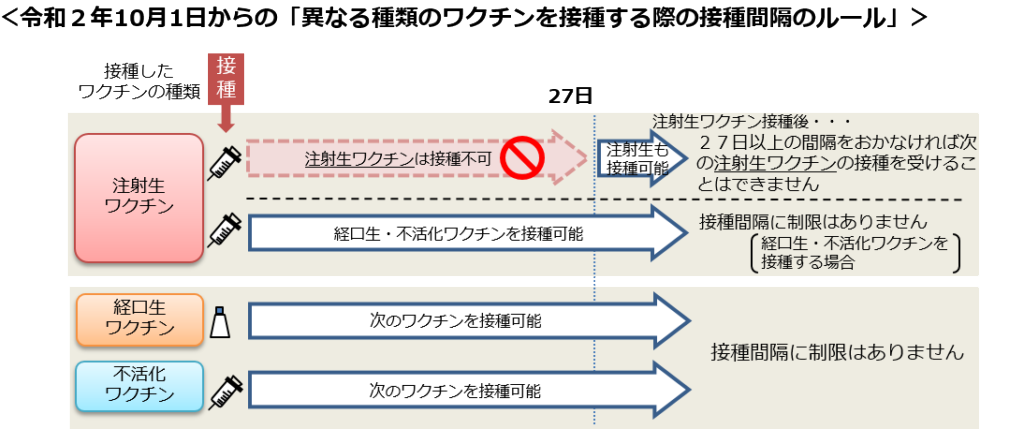
The figure is quoted from the notice on the revision of the rules for vaccination intervals on the Ministry of Health, Labour and Welfare website
For details, please refer to this page of the Ministry of Health, Labour and Welfare.
Vaccines Needed by Region
Based on the postings of the Quarantine Stations of the Ministry of Health, Labour and Welfare (FORTH), we have compiled the diseases that pose an infection risk in each region and that are considered preventable, or whose severity can be reduced, through vaccination.
You can look up the types of vaccines and schedules for each destination below.
◎: Diseases with a high infection rate or a tendency to become severe. We recommend vaccination.
✓: Please consider vaccination in line with your activities on site and your age, whether for a long stay or even a short one.
△: The risk is considered relatively low, but we may recommend vaccination depending on your activities on site, your age and similar factors.
●: If you are traveling to a country where there is a risk of infection (please refer to the website of the Quarantine Stations of the Ministry of Health, Labour and Welfare, FORTH), vaccination is required at least 10 days before travel.
Clicking on each region will jump you to a more detailed explanation.
| Region | Hepa- titis A | Hepa- titis B | Measles Rubella | Teta- nus | Po- lio | Japanese encephalitis | Ra- bies | Ty- phoid | Meningo- coccus | Tick-borne encephalitis | Influ- enza | Yellow fever |
|---|---|---|---|---|---|---|---|---|---|---|---|---|
| North America | △ | △ | ◎ | ◎ | △ | ✓ | ||||||
| Caribbean | ✓ | ✓ | ◎ | ◎ | ✓ | ✓ | ✓ | |||||
| Central America South America | ◎ | ✓ | ◎ | ◎ | ✓ | ◎ | ✓ | ● | ||||
| Central Asia Western Asia | ◎ | ✓ | ◎ | ◎ | ✓ | ✓ | ✓ | △ | ✓ | |||
| East Asia | ◎ | ✓ | ◎ | ◎ | ✓ | ✓ | ✓ | ✓ | ||||
| Southeast Asia | ◎ | ✓ | ◎ | ◎ | ✓ | ✓ | ✓ | ◎ | ✓ | |||
| South Asia | ◎ | ✓ | ◎ | ◎ | ✓ | ◎ | ◎ | ◎ | ✓ | |||
| Australia New Zealand | △ | △ | ◎ | ◎ | △ | ✓ | ||||||
| Oceania | ✓ | ✓ | ◎ | ◎ | ✓ | ✓ | ||||||
| North Africa East Africa Central Africa West Africa | ◎ | ✓ | ◎ | ◎ | ✓ | ✓ | ✓ | ◎ | ✓ | ● | ||
| Southern Africa | ◎ | ✓ | ◎ | ◎ | ✓ | ✓ | ✓ | ✓ | ||||
| Northern Europe Western Europe Southern Europe | △ | △ | ◎ | ◎ | △ | ✓ | ||||||
| Eastern Europe | ✓ | ✓ | ◎ | ◎ | ✓ | △ | ✓ |
The yellow fever vaccine can only be given at quarantine stations and similar facilities. Please note that we cannot administer it at our clinic.
Vaccination Schedule
The numbers of doses and intervals below are guidance for adults. We recommend that the schedule up to weeks 5 to 8 be completed before travel.
For the schedule from 6 months onward, please be vaccinated at your destination or when you return home temporarily.
If you do not get vaccinated, the primary series will remain incomplete and in some cases you may have to start over, so be sure not to miss it.
For tetanus, polio and Japanese encephalitis, the intervals shown are those from the primary series in cases where the primary series was not completed through routine vaccination in childhood.
Accelerated Vaccination is a method of giving the 3 doses of the primary series in as little as 1 month in order to raise antibody titers over a short period.
However, since the primary series is completed by a 4th dose 1 year later, you will receive 1 more dose than usual.
Accelerated Vaccination is available for Twinrix, the combination vaccine for hepatitis A and hepatitis B.
| Preventable disease | Product name | Approved in Japan | First dose | 1 wk | 2 wk | 3 wk | 1 mo | 2 mo | 3 mo | 6 mo | 9 mo | 1 yr |
|---|---|---|---|---|---|---|---|---|---|---|---|---|
| Hepatitis A | Aimmugen | ✓ | ① | ② | ③ | |||||||
| Havisure | - | ① | ② | |||||||||
| Hepatitis B | Bimmugen | ✓ | ① | ② | ③ | |||||||
| Hepatitis A Hepatitis B | Twinrix (standard vaccination) | - | ① | ② | ③ | |||||||
| Twinrix (Accelerated Vaccination) | - | ① | ② | ③ | ④ | |||||||
| Measles Rubella Mumps | Priorix | - | ① | ② | ||||||||
| Varicella | Freeze-dried live attenuated varicella vaccine | ✓ | ① | ②* | ||||||||
| Tetanus | Tetanus toxoid | ✓ | ① | ②* | ③* | |||||||
| Tetanus Pertussis Diphtheria (Tdap) | Boostrix | - | ① | ②* | ③* | |||||||
| Tetanus Pertussis Diphtheria Polio (DPT-IPV) | Tetraxim | - | ① | ②* | ③* | |||||||
| Polio (IPV) | Imovax Polio | ✓ | ① | ②* | ③* | |||||||
| Haemophilus influenzae type b (Hib) | ActHIB | ✓ | ① | |||||||||
| Japanese encephalitis | ENCEVAC | ✓ | ① | ②* | ③* | |||||||
| Rabies | ChiroRab | - | ① | ② | ③ | |||||||
| Typhoid | Typbar TCV | - | ① | |||||||||
| Meningococcus Meningitis ACWY | Nimenrix | - | ① | |||||||||
| Meningococcus Meningitis B | Bexsero | - | ① | ② | ||||||||
| Tick-borne encephalitis | FSME-IMMUN (standard vaccination) | - | ① | ② | ③ | |||||||
| FSME-IMMUN (Accelerated Vaccination) | - | ① | ② | ③ | ||||||||
| Influenza | Influenza HA vaccine*2 | ✓ | ① | |||||||||
| Shingles | Shingrix | ✓ | ① | ② | ||||||||
| COVID virus | Comirnaty*3 (by appointment only) | ✓ | ① | |||||||||
| Human papilloma virus | Silgard 9 | ✓ | ① | ② | ③ | |||||||
*If the primary series was completed in childhood, 1 dose is given; if it was not completed, 3 doses are given.
*2 The influenza vaccine can only be given during the epidemic season (approx. October to February).
*3 The COVID vaccine is by appointment only. If you wish to be vaccinated, please contact us in advance via LINE.
Precautions After Vaccination
After vaccination, please note the following 3 points.
Monitor your own condition for about 1 hour after vaccination.
This is because, although extremely rare, serious adverse reactions (anaphylaxis) can occur.
Please avoid drinking alcohol and strenuous exercise.
You may go about your day as usual on the day of vaccination. Bathing is not a problem, but avoid long soaks.
Local reactions such as redness at the site of administration, and rarely systemic reactions, can occur up to about 2 weeks after vaccination.
Reported systemic reactions include symptoms such as convulsions, fever, headache and muscle pain.
If symptoms that appear to be adverse reactions occur, or if they interfere with your daily life, please contact us and come in for a consultation.
Malaria and Prevention Medication
Malaria is a disease transmitted by Anopheles mosquitoes and caused by malaria parasites. It develops after an incubation period of about 10 to 30 days.
When an Anopheles mosquito feeds on blood, malaria parasites are introduced into the body, and the parasites multiply in liver cells over 10 to 30 days (this period is called the incubation period).
Without prophylaxis, a 1-month stay in West Africa is said to carry an infection rate of approximately 3%, and a 1-month stay in tropical Africa approximately 0.2%; infection can be fatal and is extremely dangerous.
If you are traveling to a malaria-endemic area, do so with correct knowledge and prevention medication.
Types and Symptoms of Malaria
Malaria is classified into 5 types according to the parasite, and among them falciparum malaria is called malignant malaria; in travelers without immunity it is an extremely urgent disease that can be fatal if appropriate medical care is not provided.
| Falciparum malaria | Vivax malaria | Ovale malaria | Quartan malaria |
|
|---|---|---|---|---|
| Initial symptoms | Fever and headache | |||
| Subsequent course | Multiple organ failure Death | Fever every 48 hours | Fever every 72 hours |
|
| Main endemic areas | Africa Papua New Guinea etc. | Indonesia India Brazil etc. | Africa, etc. | |
| Classification | Malignant malaria | Benign malaria | ||
Note: In addition to the 4 types of malaria above, there is also simian malaria.
Endemic Areas and Risk
The main endemic areas for malaria are tropical and subtropical regions such as sub-Saharan Africa, Southeast and South Asia, Central and South America, Papua New Guinea and the Solomon Islands.
In particular, those staying 1 week or longer in a highly endemic malaria area must take malaria prevention medication.
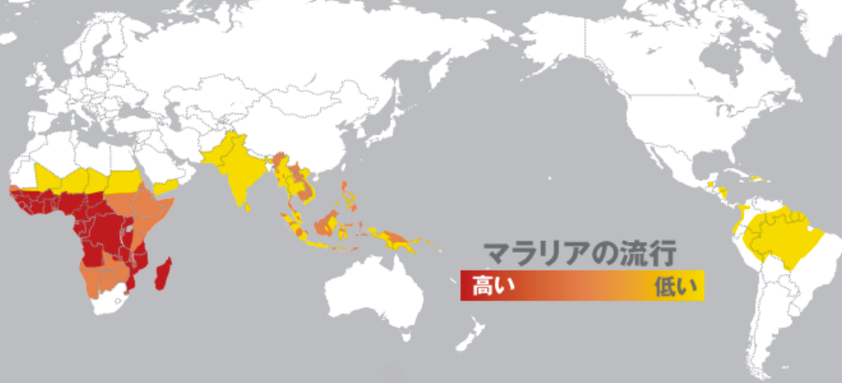
Figure: Quoted from “Malaria Prevention Pocket Guide”, Travel Clinic, Disease Control and Prevention Center, National Center for Global Health and Medicine
According to the expert committee on malaria prevention, malaria prevention medication is absolutely indicated for the following people.
– Those staying 1 week or longer in a highly endemic area
– Those staying in an area with no appropriate medical facilities should malaria develop
The risk of contracting malaria varies with the place of stay, the season, the altitude and other factors.
We have summarized the risks in the table below; please take a look.
| Higher risk | Lower risk | |
|---|---|---|
| Place of stay | Rural areas | Urban areas |
| Length of travel | Long | Short |
| Season | Late in the rainy season | Late in the dry season |
| Altitude | Low (near water) | High (2000 m or higher) |
| Place of activity | Outdoors | Indoors |
| Time of day of activity | Nighttime | Daytime |
| Accommodation | Lodgings with open windows | Hotels with air conditioning |
Without taking malaria prevention medication, a 1-month stay in tropical Africa is said to carry an infection rate of approximately 0.2%, and in West Africa approximately 3%.
Types and Characteristics of Malaria Prevention Medication
Onset of malaria can be prevented in over 90% of cases if the medication is taken correctly.
In Japan, Malarone and Mephaquin are approved, while doxycycline is not.
The characteristics of each medication are shown below.
Characteristics: It is effective not only against malaria parasites in the blood but also against those in the liver, and a distinguishing feature is that the period of use after leaving a malaria-endemic area can be shorter than with other medications.
How to take it: It must be taken daily, which is convenient for short stays.
Safety: It is a relatively new medication, and there is not yet much long-term safety data. It also cannot be used in pregnant women or in those with renal impairment.
Side effects: Gastrointestinal symptoms such as diarrhea and abdominal pain are said to occur in about 1 in 10 to 20 people. Symptoms such as nightmares are also seen rarely. It tends to have fewer side effects than Mephaquin.
Drug price: 750 JPY per 1 tablet [For a 2-week trip, about 22 days of use is required]
Characteristics: It is not effective against malaria parasites in the liver, and must be continued for 4 weeks after leaving a malaria-endemic area.
How to take it: It only needs to be taken once a week, which is convenient for long stays. On the other hand, it must be continued for 4 weeks even after leaving a malaria-endemic area.
Safety: Safety data has been accumulated in Japan and abroad since the 1970s, and in the United States and elsewhere its use is also permitted in children and pregnant women. On the other hand, it cannot be used by those with depression or epilepsy (including those with a treatment history).
Side effects: Dizziness is said to occur in 1 in 10 people. Gastrointestinal symptoms such as diarrhea and nausea are said to occur in about 1 in 25 to 30 people. Symptoms such as insomnia and depression are rarely seen.
Drug price: 1,100 JPY per 1 tablet [For a 2-week trip, 8 weeks (9 tablets) are required]
[Comparison of Malarone and Mephaquin]
| Malarone (Malarone) | Mephaquin (Mefloquine) |
|
|---|---|---|
| Approval in Japan | Approved | Approved |
| Indication | Suited to short stays | Suited to long stays |
| Contraindications (those who cannot use it) | Those with severe renal impairment | Those with depression or epilepsy (including a past history) |
| Pregnant women | Cannot be used | Cannot be used (please consult us) |
| Children | Can be used | Cannot be used (please consult us) |
| Side effects | Diarrhea and abdominal pain Nightmares | Dizziness Diarrhea and nausea Insomnia, depression, etc. |
| Drug price (JPY) | 750/tablet | 1,100/tablet |
| How to use the medication | Start taking it 1 to 2 days before travel Take 1 tablet once a day Continue for 1 week after returning home | Start taking it 1 to 2 weeks before travel Take 1 tablet once a week Continue for 4 weeks after returning home, then finish |
If you wish to use Vibramycin, which is not approved in Japan, as a malaria prevention medication, please consult with the doctor.
Mosquito Measures Other Than Prevention Medication
Anopheles mosquitoes are said to feed most actively from dusk until dawn, so avoid going out at night in particular.
Also check whether your accommodation provides a mosquito net. Mosquito coils and the like are also useful.
In addition to the prevention medication above, an insect repellent called DEET is also effective. If you use an insect repellent spray, choose one that contains DEET.
Dengue fever in Southeast Asia, and yellow fever in Africa and South America, are likewise transmitted by mosquitoes and produce symptoms very similar to malaria. These diseases are transmitted not by Anopheles mosquitoes but by Aedes mosquitoes, and since Aedes mosquitoes feed actively during the day, it is important to take care not to be bitten during daytime hours as well.
Prices
Travel Medicine is self-pay (outside insurance coverage).
Self-pay fees are calculated using the price calculation below.
[Total Price] = [Consultation fee] + [Testing fee] + [Medication fee]
Initial and Follow-Up Consultation Fees
The consultation fee differs between first visits and follow-up visits.
Anyone who has visited us even once, whether under insurance or self-pay, will be seen at the follow-up visit fee.
Initial consultation fee: 2,500 JPY
Follow-up consultation fee: 1,000 JPY
No follow-up consultation fee is charged for the second and subsequent vaccinations. Only the vaccine fee is payable each time.
Vaccine Fees
The vaccines we carry are as follows.
We can administer or prescribe all of the medications we carry on the same day.
| Preventable disease | Product name | Approved in Japan | Vaccine type | Price per dose (JPY) | Number of doses |
|---|---|---|---|---|---|
| Hepatitis A | Aimmugen | ✓ | Inactivated vaccine | 16,500* | 3 doses |
| Twinrix | - | Inactivated vaccine | 13,000 | 3 doses (Accelerated Vaccination available) |
|
| Havisure | - | Inactivated vaccine | 13,000 | 2 doses | |
| Hepatitis B | Bimmugen | ✓ | Inactivated vaccine | 7,000 | 3 doses |
| Twinrix | - | Inactivated vaccine | 13,000 | 3 doses (Accelerated Vaccination available) |
|
| Measles Rubella Mumps | Priorix | - | Live vaccine | 10,000 | 1 to 2 doses |
| Varicella | Freeze-dried live attenuated varicella vaccine | ✓ | Live vaccine | 8,000 | 1 dose or 2 doses*2 |
| Tetanus | Tetanus toxoid | ✓ | Inactivated vaccine | 4,000 | 1 dose or 3 doses*2 |
| Tetanus Pertussis Diphtheria (Tdap) | Boostrix | - | Inactivated vaccine | 9,000 | 1 dose or 3 doses*2 |
| Tetanus Pertussis Diphtheria Polio (DPT-IPV) | Tetraxim | - | Inactivated vaccine | 12,000 | 1 dose or 3 doses*2 |
| Polio (IPV) | Imovax Polio | ✓ | Inactivated vaccine | 9,000 | 1 dose or 3 doses*2 |
| Haemophilus influenzae type b (Hib) | ActHIB | ✓ | Inactivated vaccine | 8,500 | 1 dose |
| Japanese encephalitis | ENCEVAC | ✓ | Inactivated vaccine | 7,500 | 3 doses |
| Rabies | ChiroRab | - | Inactivated vaccine | 13,000 | 3 doses |
| Typhoid | Typbar TCV | - | Inactivated vaccine | 10,000 | 1 dose |
| Meningococcus Meningitis ACWY | Nimenrix | - | Inactivated vaccine | 17,000 | 1 dose |
| Meningococcus Meningitis B | Bexsero | - | Inactivated vaccine | 25,000 | 2 doses |
| Tick-borne encephalitis | FSME-IMMUN | - | Inactivated vaccine | 12,000 | 3 doses |
| Influenza | Influenza HA vaccine*3 | ✓ | Inactivated vaccine | 3,500 | 1 dose as a rule |
| Shingles | Shingrix | ✓ | Inactivated vaccine | 22,000 | 2 doses |
| COVID virus | Comirnaty*4 (by appointment only) | ✓ | Inactivated vaccine | 16,000 | 1 dose |
| Human papilloma virus | Silgard 9 | ✓ | Inactivated vaccine | 30,000 | 3 doses as a rule (2 doses also possible) |
*Those who began Aimmugen vaccination at our clinic on or before July 22, 2026 may continue at the price applicable before the change.
*2 If the primary series was completed in childhood, 1 dose is given; if it was not completed, the prescribed number of doses must be given.
*3 The influenza vaccine can only be given during the epidemic season (approx. October to February).
*4 The COVID vaccine is by appointment only. It can only be given during the epidemic season (approx. October to February). If you wish to be vaccinated, please contact us in advance via LINE.
Medication Fees
The medications we carry are as follows. All can be prescribed in-house on the same day. There is no need to go to a pharmacy.
| Type | Medication name | Price (JPY) |
|---|---|---|
| Malaria prevention medication | Malarone (take 1 tablet once a day) | 750/day |
| Mephaquin (take 1 tablet once a week) | 1,100/week | |
| Altitude sickness prevention medication package | Diamox* (5 tablets) Anti-nausea medication (5 doses) Antipyretic analgesic (10 doses) | 3,000 |
| Travel package | Antipyretic analgesic (5 doses) Gastrointestinal medication, intestinal regulator and antiallergic medication (5 days each) Antidiarrheal, motion sickness medication and laxative (5 doses each) Ointment and insect bite remedy (1 bottle) | 3,000 |
| Pain relief package | Antipyretic analgesic (5 doses) | 500 |
*Diamox, an altitude sickness prevention medication, is recommended to be started 1 day before climbing and continued until 2 days after reaching the summit or until you descend. Diamox can also be added, so please consult with the doctor.
If you wish to use Vibramycin, which is not approved in Japan, as a malaria prevention medication, please consult with the doctor.
Testing Fees
The tests we can perform are as follows. Results for tests other than same-day testing will be sent by email.
| Test item | Price (JPY) | Test results* | Site |
|---|---|---|---|
| Measles IgG antibody | 3,000 | 3 to 4 days later | Blood |
| Rubella IgG antibody | 3,000 | 3 to 4 days later | Blood |
| Mumps IgG antibody | 3,000 | 3 to 4 days later | Blood |
| Varicella IgG antibody | 3,000 | 3 to 4 days later | Blood |
| Measles, rubella and mumps IgG antibody package | 8,000 | 3 to 4 days later | Blood |
| Measles, rubella, mumps and varicella IgG antibody package | 10,000 | 3 to 4 days later | Blood |
| Hepatitis A antibody test | 4,500 | 3 to 4 days later | Blood |
| Hepatitis B antigen test | 4,500 | 3 to 4 days later | Blood |
| Hepatitis B antibody test | 4,500 | 3 to 4 days later | Blood |
| Hepatitis C antibody test | 4,500 | 3 to 4 days later | Blood |
| Tuberculosis blood test*2 (T-SPOT) | 9,900 | 2 to 3 days later | Blood |
| HIV antigen/antibody test | 4,500 | 3 to 4 days later | Blood |
| HIV real-time PCR | 11,000 | 7 to 10 days later | Blood |
| Syphilis (qualitative/quantitative test) | 4,500 | 3 to 4 days later | Blood |
| General blood draw package (lifestyle-related diseases, etc.) | 3,000 | 2 to 3 days later | Blood |
| HIV antigen/antibody test (4th-generation same-day testing) | 6,000 | Approx. 30 minutes | Blood |
| Hepatitis B (HBs antigen same-day testing) | 6,000 | Approx. 30 minutes | Blood |
| Syphilis (same-day, TPHA method) | 6,000 | Approx. 30 minutes | Blood |
*The number of days for reporting test results is a guide counted from the “test start date”. For samples taken after early evening on the day, or on Sundays, public holidays or over the New Year period, the next business day becomes the “test start date”. For self-pay care, results can be checked on the web.
*2 Testing is available only on Mondays, Tuesdays, Wednesdays and Fridays, and is by appointment. If you wish to be tested, please contact us via LINE at least 3 business days before the test date.
Issuance of Certificates
For those who require a medical certificate or referral letter from us, the fees are as follows.
| Content | Price (JPY) |
|---|---|
| Various certificates (Japanese) | 3,300 |
| Various certificates (English) | 5,500 |
Consultation Process
As with our other departments, Travel Medicine gives priority to those with appointments.
Visiting without an appointment is expected to involve a long wait, so please make an appointment and fill in the medical questionnaire in advance.
Appointment
Please book from “In-person consultation” on our LINE rich menu.
Filling in the medical questionnaire
Please fill in the medical questionnaire from the link on our Official LINE.
Visiting on the day
Please come in at your appointment time on the day. We will hand you a number at reception and call you by number for testing, payment and so on.
Medical interview and consultation with the doctor
Based on your medical questionnaire, we provide appropriate advice, testing and treatment. Vaccination and prescriptions on the same day are also possible.
Health Check for Workers Posted Overseas
We provide health checks for those being posted overseas.
We offer care in the evenings and on weekends, with attention to privacy, and provide an environment that is easy to visit for people of every generation and gender.
The results of our health checks are, as a rule, sent within 1 week by email (by post as well if required), so there is no need to come back to our clinic.
We also accept the JICA Japan Overseas Cooperation Volunteers health check and health checks for study abroad or visas, so please contact us via LINE.
The health checks we provide are as follows. Health check results will be sent by email.
The amount includes the consultation fee, so there are no prices beyond those listed.
Express service (1,100 JPY), postal delivery of results (500 JPY) and issuance of a medical certificate (3,300 JPY) incur separate fees.
Price: 13,000 JPY (consultation fee included)
Description of the check: The minimum necessary health check before and after being posted overseas, as required by the Industrial Safety and Health Act.
Time required: approximately 45 to 60 minutes (the chest X-ray may be taken on a later date)
Test contents: Doctor’s consultation, physical measurements, blood test, urine test, hearing test, vision test, electrocardiogram and chest X-ray examination*
Test results: Sent by email within 1 week after the chest X-ray is taken (by post as well if desired)
*This will be taken at our Partnered Clinic (about 2 minutes on foot). There is no payment whatsoever at the Partnered Clinic.
Influenza Prevention Medication
We carry influenza prevention medication.
Starting it within 48 hours of contact with an influenza patient is said to reduce onset by 60 to 90%. If you wish to lower your risk of infection, such as before travel or study abroad, please consult us.
*It is not a substitute for vaccination (it can be used alongside it).
Influenza vaccination on the same day is also possible!
There is no insurance coverage for influenza prevention medication or the influenza vaccine.
– Those with plans they want to avoid falling ill for, such as overseas travel, study abroad, long business trips or entrance examinations
– Those living together with patients, such as family members in the same household or in dormitories
– Older people and those with complications such as chronic respiratory disease, heart disease, diabetes or renal impairment (the doctor will determine whether it is indicated)
The influenza prevention medications we carry are as follows.
A doctor’s consultation is always required for a prescription of influenza prevention medication.
A consultation fee (2,500 JPY for a first visit, 1,000 JPY for a follow-up) is required separately.
| Product name | How to take it | Price (JPY) |
|---|---|---|
| Oseltamivir (generic Tamiflu) | Start within 48 hours of contact Take 1 capsule once a day for 10 days* | 5,000 |
| Inavir | Start within 48 hours of contact 40 mg inhaled 1 time*2 | 7,000 |
*For adults. We do not prescribe it for children weighing under 37.5 kg.
*2 For those aged 10 and over. For those under 10, the dose is 20 mg (4,000 JPY). It cannot be used by children who are unable to inhale.
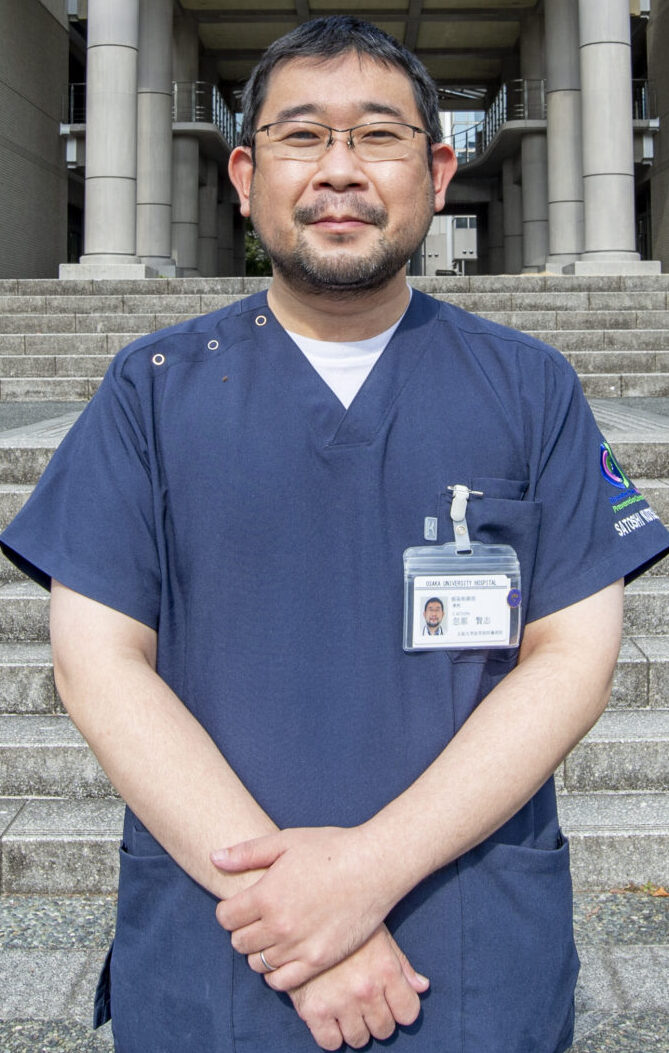
[Dr. Satoshi Kutsuna]
Specialist in infectious disease internal medicine, PhD in medicine.
For about 10 years he was engaged in travel medicine and imported infectious disease care at the National Center for Global Health and Medicine Hospital (Shinjuku-ku, Tokyo), home to Japan's largest travel clinic, and he continues to be involved in activities including clinical practice and research today.
His other areas of specialty are emerging and re-emerging infectious diseases and COVID infection, and he works to raise awareness of infectious diseases through a variety of outlets including the media and the internet.
He also sees patients at our clinic as a part-time physician and supervises our Travel Medicine.