Could You Have Syphilis Without Knowing It? What to Do If You're Worried
Syphilis is a disease caused by a bacterium called “Treponema.” It is transmitted through sexual contact such as genital-to-genital contact, genital-to-anal contact (anal sex), and genital-to-oral contact (oral sex).
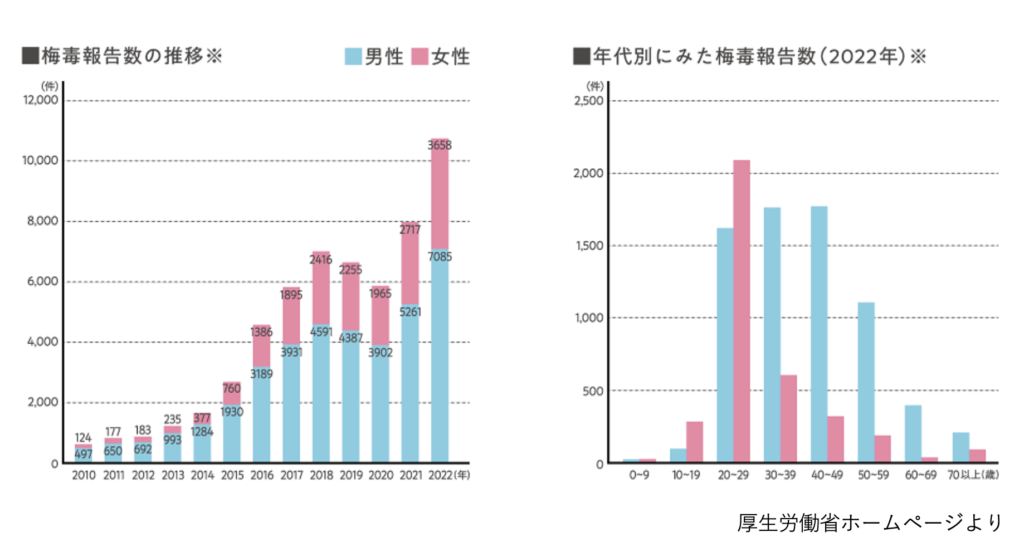
Originally, there were around 500 reported cases per year in Japan, but the number began to rise sharply around 2010, exceeding ten thousand cases in 2022, and infections continue to spread even now.
This article summarizes the symptoms, testing, and treatment of syphilis in an easy-to-understand way.
▶Please also see our blog that briefly summarizes syphilis testing, diagnosis, and treatment.
– Syphilis has been increasing significantly in recent years.
– Syphilis is often asymptomatic and its symptoms vary widely, so without testing, you cannot know whether you are infected. You may unknowingly infect others.
– Once 4 weeks have passed since a possible infection event, you can undergo either the same-day test or the standard test.
– Treatment methods are well established, and prompt treatment is available at our clinic.
Clicking each item in the table of contents will take you directly to that section of the article.
Please select the section to jump to.
Note that the prices indicated in this page are all inclusive of tax.
Syphilis Is Increasing
Syphilis has been increasing in recent years, but how significant has this recent increase actually been?
As shown in the figure below, syphilis has been increasing rapidly since 2021. Among men, cases have been reported broadly across those in their 20s to 50s, while among women, the number of reported cases is notably high among those in their 20s. In addition, infections among teenagers are a situation that cannot be ignored.
In Osaka, the number of reported cases in October 2022 was 1,337. This already exceeded, as of week 38, the 1,188 cases reported in 2018 — the highest annual number of reported cases since 1999, when syphilis was designated a disease subject to full case-based surveillance under the National Epidemiological Surveillance of Infectious Diseases — showing that the number of reported infections has increased dramatically.
One reason thought to underlie this rapid spread of infection is the delay in detecting syphilis.
Reasons for this delayed detection include the fact that people often do not notice the symptoms in the first place, and that it takes time for symptoms to appear after infection.
Why Is It Hard to Notice the Symptoms of Syphilis?
Syphilis is classified into four stages.
Nowadays, syphilis is a treatable disease. Cases that progress to the third or fourth stage are rarely seen. Here, we will discuss the first and second stages.
In about thirty percent of patients, a hard lump forms at the genital area (the site of entry) around 3 weeks after infection.
The lump disappears quickly, but in rare cases it can become an ulcer. In addition, the lymph nodes in the groin area may become swollen.
Even if an ulcer forms or the lymph nodes swell, there is no pain. Even when symptoms appear, most people remain unaware of them, and this leads to sexual activity with partners or an unspecified number of other people.
From 3 months to 3 years after infection, in addition to swelling of lymph nodes throughout the body, symptoms such as fever, malaise, and joint pain may appear.
A characteristic generalized rash known as “bara-shin” (rose rash) may appear, with prominent red rashes spreading from the palms and soles across the entire body and appearing on the face as well. It disappears in about 1 month even without treatment, but unless treated, Treponema remains in the body.
By the time this easily noticeable, characteristic finding appears, around 3 months have already passed since infection, and during this time the infection may have already been spread to a partner or to an unspecified number of other people.
How Can You Find Out If You Are Infected with Syphilis?
After infection, syphilis may not show a positive result right away. Please make sure to get tested only after 4 weeks have passed since the possible infection event.
There are two testing methods for syphilis: the same-day test and the standard test.
At our clinic, you can undergo either the same-day test, which gives results on the same day, or the standard test, which can determine your current infection status even if you have been infected before.
Price: 6,000 JPY
When available: 4 weeks or more after a possible infection event
Method: blood draw
Results: after 30 minutes (explained at the clinic)
Note: not available to those who have previously been infected with syphilis.
Price: 4,500 JPY
When available: 4 weeks or more after a possible infection event
Method: blood draw
Results: after 4 to 5 business days (confirmed by email)
Note: also available to those who have previously been infected with syphilis.
Interpreting Syphilis Test Results
In the standard syphilis test (RPR / TP test), two tests are performed, and the stage of infection is estimated and treatment decisions are made based on the results.
RPR is a method that tests for antibodies produced as a result of syphilis infection (indicating disease activity). TP testing, on the other hand, detects antibodies against syphilis itself.
Broadly speaking, the results can be interpreted as follows.
| RPR | TPHA | Interpretation of Results |
|---|---|---|
| Negative | Negative | Syphilis negative* |
| Positive | Negative | Biological false positive* |
| Positive | Positive | Syphilis positive or antibody carrier after treatment* |
| Negative | Positive | Antibody carrier after syphilis treatment*2 |
*Rarely, early-stage infection *2 Rarely, TP antigen-based false positive
The rapid test uses the TP method, and since it remains positive if you have had the infection in the past, this test alone cannot determine “whether you are currently infected” for those who have previously had syphilis. If you have previously been infected with syphilis, be sure to undergo the standard test.
Results are judged not only by negative/positive but also by looking at the numerical values, so if you are unsure how to interpret your results, please consult a doctor.
How Is Syphilis Treated?
Nowadays, as long as it is not detected too late, syphilis is a disease that can be treated relatively easily.
Penicillin-based and other antibacterial drugs are effective against syphilis. In Japan, oral antibacterial treatment has commonly been used.
In September 2021, benzathine benzylpenicillin intramuscular injection, the global standard treatment for syphilis, was approved for manufacture and sale in Japan.
For oral treatment, the duration is determined based on factors such as the stage of infection. If you stop taking the medication partway through because your symptoms have improved, the infection can recur. Be sure to complete the full course.
As shown below, the duration of treatment needed for syphilis varies depending on how much time has passed since infection.
Injection: 1 time
Oral medicine: about 2 weeks (3 times a day, 2 tablets each time)
Injection: 3 times (once a week)
Oral medicine: about 4 weeks or more (3 times a day, 2 tablets each time)
The approximate price of syphilis treatment is as follows. We offer both self-pay and insurance-covered treatment. If you use self-pay treatment, a “Medical Expense Notice” will not be sent to your home, so you can receive consultation and treatment without anyone else finding out.
Oral medicine for 2 to 4 weeks: 5,500 JPY per week’s supply
Injection: 19,000 JPY per session
You may develop a fever after syphilis treatment.
Fever occurring within 24 hours after syphilis treatment happens with a probability of 10% to 35%. It is especially common in those receiving treatment for early-stage syphilis.
In addition to fever, symptoms such as headache, muscle pain, chills, and worsening of the rash (if a rash was present at the start of treatment) may also occur. With both injection and oral treatment, symptoms often appear within 1 hour.
This is called the Jarisch-Herxheimer Reaction, and the detailed reason why fever occurs is not known.
In most cases, the symptoms resolve on their own within about 12 to 24 hours without treatment, but it is also fine to use antipyretic medication.
How Can Syphilis Be Prevented?
Using condoms is effective for prevention. However, infection can still occur if there are lesions on skin or mucous membranes not covered by the condom.
If you have symptoms that make you suspect infection, please visit a medical institution promptly. For those who engage in sexual activity frequently, we recommend undergoing regular STI testing.
Early detection through testing and early treatment are important for protecting yourself and your partner.
After Treatment, Be Sure to Get Tested to Confirm You Are Cured
After syphilis treatment, a blood test is performed 1 month later to confirm that you are cured and that there is no recurrence. Your attending doctor will explain the details. Insurance coverage is also available, so please consult with the doctor.
Q&A About Syphilis
Below is a summary of frequently asked questions about syphilis.
Does having syphilis make you more susceptible to HIV infection as well?
In addition to syphilis, being infected with STIs such as gonorrhea or chlamydia weakens the mucosal tissue, which increases the risk of HIV infection several times over.
If syphilis infection is suspected, we recommend undergoing an HIV test at the same time.
I've had syphilis once before — does that mean I won't get it again?
Even if syphilis is fully cured, this does not prevent new infections in the future. Without appropriate precautions (such as condom use and partner treatment), you can contract syphilis again.
Is there a PCR test for syphilis?
It is possible to test lesions such as a chancre (hard ulcer) or mucous patches, but this is not covered by insurance. It is also known that detection sensitivity can decrease depending on the sample collection method.
If I have a history of syphilis treatment, can I still get the one-coin test?
You can still take the one-coin test itself, but the same-day test is not available to you. For those with a treatment history, our clinic's one-coin test is conducted as the standard test. It takes some time before we can give you the results (usually 3-5 days).
▶Ministry of Health, Labour and Welfare: Q&A on Syphilis
▶Osaka Prefectural Infectious Disease Information Center
▶Japanese Association for Infectious Diseases, Guidelines for the Diagnosis and Treatment of Sexually Transmitted Infections 2020
<Dr. Daisuke Shiojiri>
Director of Personal Health Clinic, M.D., Ph.D.
At the National Center for Global Health and Medicine (Shinjuku-ku, Tokyo) and Personal Health Clinic, he provides evidence-based, accurate knowledge on HIV, PrEP, and STI testing, along with medical care that is attentive to each patient's feelings.
Born in Japan but raised in Kenya, Africa, he also obtained a medical license there and has been involved in medical and educational support activities.
He also sees patients at our clinic as a part-time physician.