What Is Male Menopause (Late-Onset Hypogonadism)? — What Are the Symptoms? What Is the Process from Testing to Treatment? How Much Are the Prices? —
We provide specialized consultations for male menopause (late-onset hypogonadism) (LOH syndrome: Late-Onset Hypogonadism, pronounced “loh” syndrome).
Male menopause (late-onset hypogonadism) has attracted worldwide attention in recent years, but in Japan the term itself is not widely recognized, and people who need treatment are not able to receive satisfactory care. Recently there have also been cases of people in their 20s to 30s being treated under a diagnosis of male menopause (late-onset hypogonadism).
This article summarizes the symptoms, testing and treatment of male menopause in an easy-to-understand way.
You can check whether you may have Late-Onset Hypogonadism from the link below.
We provide testing and treatment related to Late-Onset Hypogonadism (LOH) as self-pay care in principle.
If you have any questions about Late-Onset Hypogonadism (LOH) care, please contact us through our official LINE.
Click any item in the table of contents to jump partway into the article.
Please select the section to jump to.
Note that the prices indicated in this page are all inclusive of tax.
- Symptoms of male menopause (late-onset hypogonadism)
- Testing for male menopause (late-onset hypogonadism)
- Diagnosis of male menopause (late-onset hypogonadism)
- Treatment for male menopause (late-onset hypogonadism)
- Male Menopause, ED and AGA
- How Long Does Treatment Continue?
- How to Visit for Late-Onset Hypogonadism
Symptoms of male menopause (late-onset hypogonadism)
Male menopause (late-onset hypogonadism) is said to affect approximately six million people in Japan, and it is a condition that began to be pointed out worldwide from the early 2000s (it is now sometimes described as LOH syndrome).
Male menopause (late-onset hypogonadism) is defined as “a syndrome caused by a decline in male hormone (testosterone) associated with aging and stress”, and in recent years cases of declining male hormone have also been seen in younger people (such as those in their 20s to 30s).
Male hormone has a wide range of functions — not only sperm formation and muscle strengthening but also muscle and bone, the central nervous system and the prostate, sexual function and urinary function, etc. When male menopause (late-onset hypogonadism) develops, these are impaired and various symptoms such as the following appear.
– You have decreased sexual desire (★)
– Your erections have become weaker (★)
– You have less energy
– You have a decline in physical strength or stamina
– You have become shorter
– You feel that your “daily enjoyment” has decreased
– You feel sad, or are quick to anger
– Erections have become weaker
– Your ability to exercise has declined
– You sometimes doze off after dinner
– Your work capacity has declined
Among the questions above, if both of the 2 items marked (★) apply to you, or if 3 or more items apply, you may have male menopause (late-onset hypogonadism).
Male hormones affect not only libido but also your mental state. Symptoms such as “not being able to sleep well” and “continued feelings of anxiety” are also often seen.
To measure the severity of symptoms objectively, the AMS score (male menopause questionnaire) is useful. It is also helpful when evaluating the effect of hormone treatment.
Please check your own condition from the link below.
[AMS Score]
For each answer, assign 1 to 5 points according to the severity of the symptom. The total of the 17 items indicates the degree of symptoms.
| Symptom | None | Mild | Moderate | Severe | Extremely severe |
|---|---|---|---|---|---|
| Feeling unwell both physically and mentally | 1 | 2 | 3 | 4 | 5 |
| Pain in joints or muscles (back pain, joint pain, etc.) | 1 | 2 | 3 | 4 | 5 |
| Sweating and hot flashes | 1 | 2 | 3 | 4 | 5 |
| Unable to sleep, or sleeping lightly | 1 | 2 | 3 | 4 | 5 |
| Becoming sleepy often Frequently feeling tired | 1 | 2 | 3 | 4 | 5 |
| Feeling irritable or bad-tempered | 1 | 2 | 3 | 4 | 5 |
| Having become nervous | 1 | 2 | 3 | 4 | 5 |
| Becoming anxious easily | 1 | 2 | 3 | 4 | 5 |
| Lacking motivation, feeling apathetic Fatigue that does not go away | 1 | 2 | 3 | 4 | 5 |
| Feeling a decline in muscle strength | 1 | 2 | 3 | 4 | 5 |
| Feeling depressed or powerless | 1 | 2 | 3 | 4 | 5 |
| Feeling that your peak has passed | 1 | 2 | 3 | 4 | 5 |
| Feeling burned out Feeling that you are at rock bottom | 1 | 2 | 3 | 4 | 5 |
| Beard growth has slowed | 1 | 2 | 3 | 4 | 5 |
| Feeling a decline in sexual ability | 1 | 2 | 3 | 4 | 5 |
| Decreased frequency of morning erections | 1 | 2 | 3 | 4 | 5 |
| Feeling a decline in sexual desire | 1 | 2 | 3 | 4 | 5 |
Source: The Japanese Urological Association / The Japanese Society for Men’s Health, “Clinical Practice Guidelines for LOH Syndrome”; Working Committee, “Clinical Practice Manual for Late-Onset Hypogonadism”
17 to 26 points: no problem
27 to 36 points: mild
37 to 49 points: moderate
50 points or more: severe
If your score is mild or above and you have symptoms that concern you, please feel free to visit us.
Testing for male menopause (late-onset hypogonadism)
Unlike menopause in women, male menopause (late-onset hypogonadism) has no fixed time of onset, and once a hormone decline occurs the symptoms may continue throughout your life.
For this reason, if you have symptoms that concern you, we recommend having testing first.
| Category | Men | Women |
|---|---|---|
| Cause | Decline in male hormone | Decline in female hormone |
| Timing | Not particularly fixed (any time from the 40s onward) | The 5 years before and after menopause (around age 50) |
| Duration | No end | Symptoms settle about 5 years after menopause |
For an initial 10,000 JPY, you can comprehensively receive the testing needed to diagnose male menopause.
When hormone therapy is given, we also recommend a PSA test (an additional 2,000 JPY) to check the risk of prostate cancer.
This is because starting male hormone therapy in someone who already has prostate cancer carries a risk of making the condition progress. (It is not a fact that male hormones cause prostate cancer.)
In addition, at the initial testing for male menopause you can receive STI screening at a special price of 10,000 JPY (normally 22,000 JPY).
Test contents: complete blood count, liver function, kidney function, electrolytes, uric acid, CK, TG, LDL, HDL, blood glucose, HbA1c, magnesium, thyroid function test, testosterone, free testosterone (10,000 JPY)
For those who wish: PSA (2,000 JPY)
STI testing (for those who wish): HIV, hepatitis B, syphilis, gonorrhea, chlamydia (3 sites: genital, throat and anus) (10,000 JPY) [Normally equivalent to 22,000 JPY]
Diagnosis of male menopause (late-onset hypogonadism)
Male menopause is diagnosed based on the results of the initial blood test package. We check the values of “free testosterone” and “testosterone” in particular, and if they are low, we consider treatment after also checking for other conditions.
If your values are normal but you have symptoms and wish to be treated, we can help. Male menopause is also strongly related to lifestyle-related diseases such as diabetes, and if the blood test shows abnormalities, treatment for those can be started in parallel.
Our certified testosterone treatment physician will propose the optimal testing and treatment for each patient’s symptoms.
Male menopause (late-onset hypogonadism) is strongly related to lifestyle-related diseases such as diabetes, and if the blood draw package shows any abnormality, treatment can also be started in parallel.
Our certified testosterone treatment physician will propose the optimal testing and treatment for each patient’s symptoms.
Treatment for male menopause (late-onset hypogonadism)
Broadly speaking, there are 3 treatments for male menopause: “lifestyle improvement”, “male hormone therapy” and “ED treatment medication”.
Lifestyle Improvement
Lifestyle improvement includes improving diet and exercise habits, the workplace environment and personal relationships, etc., but we imagine that many of these cannot be improved right away.
In addition, many people with male menopause feel a decline in physical strength, or find that the motivation to change their lifestyle does not come (this is precisely what can be called a symptom of male menopause), so we think it is also worth considering starting male hormone therapy.
Male Hormone Therapy
There are 3 ways to supplement male hormones — “injection medication”, “medication (oral)” and “topical ointment” — and we handle all of these dosage forms.
Medication options:
Injectable: short-acting male hormone (Testoviron), long-acting male hormone (Nebido generic)
Topical: Cernos Gel, Glowmin, 1UP Formula
Medication (oral): Cernos Capsule
Among these, the one we particularly recommend is treatment using a “long-acting male hormone”.
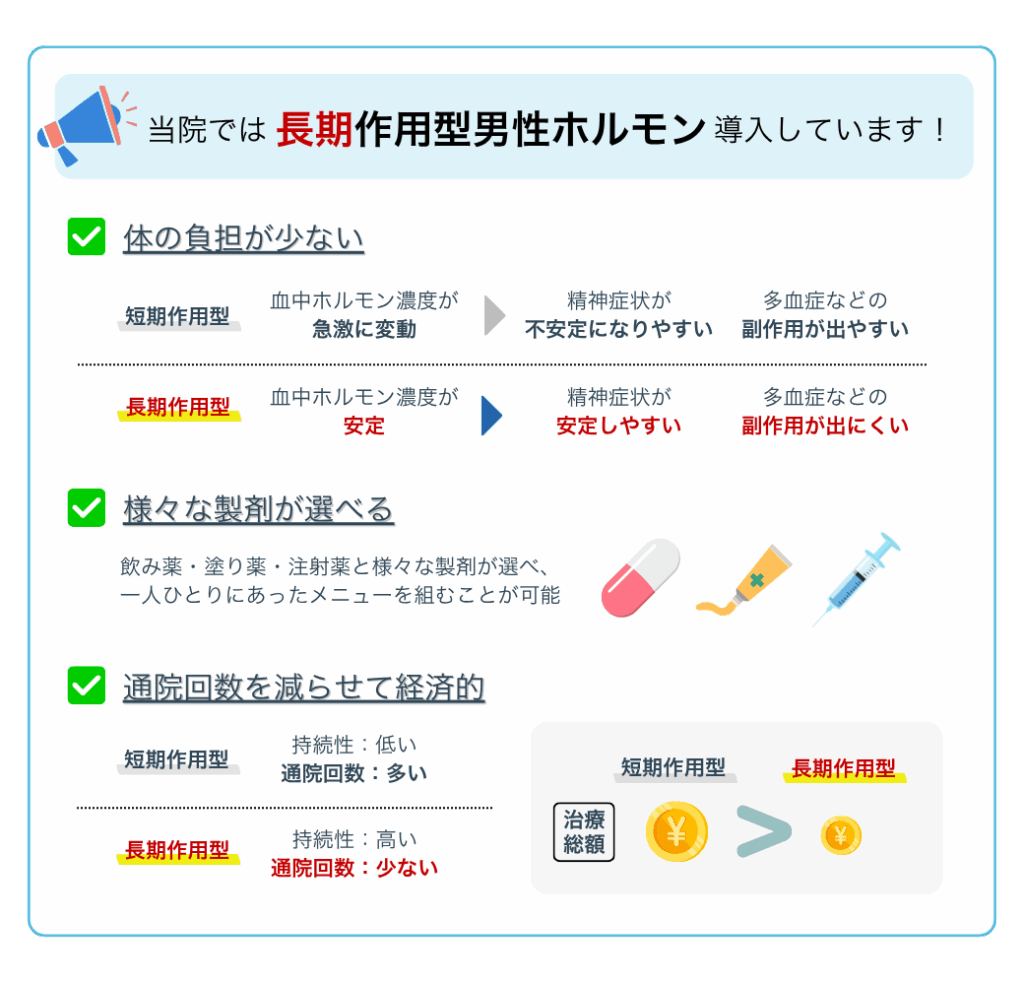
Description: This is an injection of a long-acting male hormone preparation. The frequency of use differs according to each patient’s individual situation, but it is a preparation recommended for those with strong symptoms or who want to feel the effect of treatment. Once stable, treatment every 3 to 4 months is also possible.
Price: 18,000 JPY (testosterone test included)
Description: This is a topical ointment of a long-acting male hormone preparation. The amount used and the amount prescribed differ according to each patient’s individual situation, but it allows inexpensive treatment and makes it easy to change the treatment intensity.
Please consult with a doctor at the time of your consultation for details.
Price: 4,000 to 9,000 JPY/month
Description: This is a medication (oral) of a long-acting male hormone preparation. At first it is common to take 1 to 2 tablets per day. The number of tablets can also be changed according to your symptoms.
1 box: 5,000 JPY/30 tablets
3 boxes: 14,000 JPY/90 tablets
6 boxes: 27,000 JPY/180 tablets
Male hormone therapy is a highly safe treatment, but the following side effects have been reported.
At our clinic, in addition to checking for such side effects, we can provide treatment with side effects kept as low as possible by optimizing the hormone dose based on hormone values.
– Liver dysfunction
– Polycythemia
– Increased body hair and acne
– Reduced testicular function, etc.
By periodically performing the continuation blood test package (3,000 JPY), we assess the effect of hormone therapy and propose the optimal treatment for your hormone values.
For those who wish, blood draws for lifestyle-related diseases, etc. can also be carried out.
Measurement of hormone values: testosterone, free testosterone (3,000 JPY)
Lifestyle-related disease testing (for those who wish): complete blood count, liver function, kidney function, electrolytes, uric acid, CK, TG, LDL, HDL, blood glucose, HbA1c (3,000 JPY)
The prices for each hormone therapy are as follows.
Treatment is possible from around 5,000 JPY per month, side effects are few and the medication only needs to be taken once a day, so you can start and continue treatment without hesitation.
| Type | Preparation | Price (JPY) |
|---|---|---|
| Long-acting male hormone |
Nebido generic (Cernos injection) | 18,000* |
| Nebido generic oral (Cernos capsule) | 1 box: 5,000/30 tablets 3 boxes: 14,000/90 tablets 6 boxes: 27,000/180 tablets |
|
| Testosterone topical medication | Cernos Gel (1% testosterone undecanoate topical medication) |
4,000–9,000/month*2 |
| Glowmin (1% testosterone topical skin preparation) |
4,100 | |
| 1UP Formula (5% testosterone topical skin preparation) |
Self-pay prescription fee: 2,200 (+ medication price)*3 |
|
| Short-acting male hormone | Testoviron 100mg | 2,500 |
| Testoviron 250mg | 3,500 |
*The price of hormone measurement is included.
*2 Dosage and prescribed amount vary depending on each patient’s individual situation. Please consult with the doctor for details at the time of your visit.
*3 For 1UP Formula, you will pay a self-pay prescription fee of 2,200 JPY at our clinic, and pay the medication price separately at a specialized pharmacy (approximately 12,100 JPY).
ED Treatment Medication
ED treatment medication is known to be highly effective for people with male menopause (late-onset hypogonadism) who have erectile dysfunction, etc.
In addition, recent research has shown that taking ED treatment medication not only improves ED but also raises blood testosterone values, so it is considered applicable to people with male menopause (late-onset hypogonadism) who do not have erectile dysfunction.
Since our opening, we have provided a variety of ED treatment medications matched to patients’ needs, so please consult us with peace of mind.
How to choose an ED treatment medication is explained in detail in the blog post below.
Male Menopause, ED and AGA
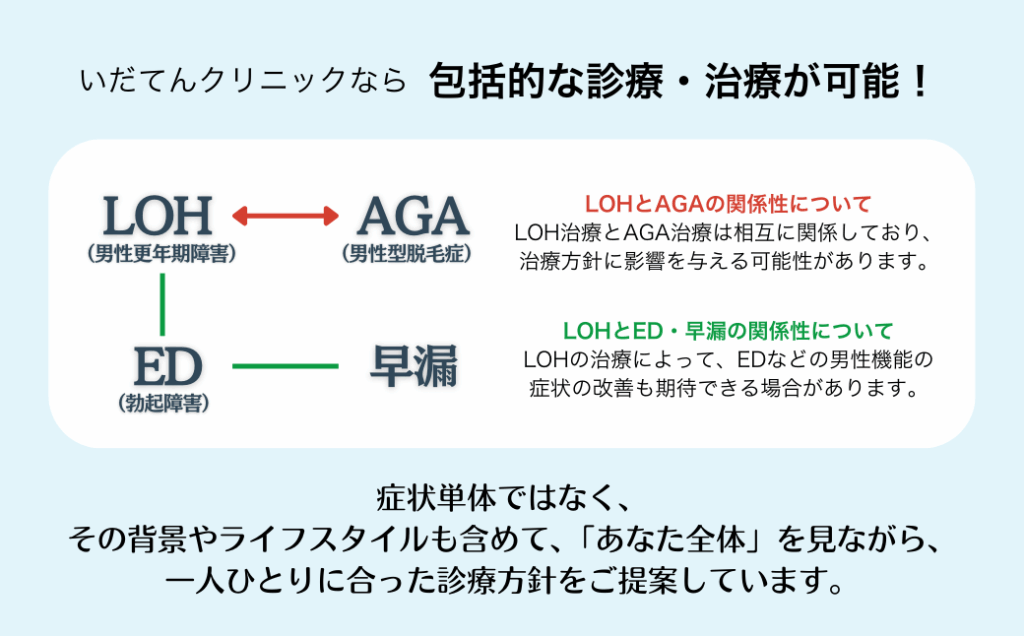
Male menopause, ED (erectile dysfunction) and AGA (androgenetic alopecia) are closely related.
Products such as finasteride and dutasteride, used in the treatment of AGA, inhibit the conversion of testosterone into DHT (dihydrotestosterone), the substance that causes AGA (androgenetic alopecia), but they are known to bring about ED and male menopause as side effects.
Conversely, treatment for male menopause can also be expected to improve male functions such as ED.
Among those with premature ejaculation, in people who also have ED there are cases where combining premature ejaculation treatment medication with ED treatment medication increases the treatment effect.
At our clinic we can provide comprehensive diagnosis and treatment not only for male menopause but also for ED, AGA and premature ejaculation.
How Long Does Treatment Continue?
We often hear patients ask about male menopause, “Won’t it be something that never gets better for the rest of my life?”
To raise male hormone values, there are first the established treatments of “male hormone therapy” and “ED treatment medication”. Furthermore, lifestyle improvement can also be expected to raise hormone values.
For example, aerobic exercise 3 times a week for 40 to 60 minutes raises male hormone values and is also effective for improving erectile strength. It has also been reported that in people with obesity, hormone values improve with dietary therapy.
However, when the symptoms of male menopause are strong it is often difficult to suddenly start exercise or dietary restriction, so we believe that by first restoring your physical strength and energy with male hormone therapy and gradually getting your lifestyle in order, you will eventually be able to taper off or even stop “male hormone therapy”.
It is best to think of male hormone therapy not as the “goal” but as training wheels for gaining a lifestyle that can maintain male hormone values.
At our clinic we provide every kind of follow-up, including your lifestyle and “sexual health”, etc.
How to Visit for Late-Onset Hypogonadism
Late-Onset Hypogonadism (LOH) care, like our other departments, is on an appointment-priority basis.
Visiting directly is expected to involve a long wait, so please make an appointment and fill in the medical questionnaire in advance.
Appointment
Please make your appointment from “In-Person Consultation” on our clinic’s official website.
Filling in the Medical Questionnaire
After your appointment is complete, please click the link shown on our official LINE or at the bottom of the appointment confirmation email, and fill in the medical questionnaire.
Visiting on the Day
Please come to the clinic at your appointment time on the day. We will give you a number at reception and call you by that number for testing, payment and so on.
Medical Interview and Consultation with a Doctor
Based on the medical questionnaire, we provide appropriate advice, testing and treatment.
<Dr. Daisuke Shiojiri>
Director of Personal Health Clinic, Doctor of Medical Science.
At the National Center for Global Health and Medicine (Shinjuku Ward, Tokyo) and at Personal Health Clinic, he provides correct, evidence-based knowledge on HIV, PrEP and other topics related to STIs and STI testing, along with care that stays close to patients' hearts.
Born in Japan but raised in Kenya, Africa, he also holds a medical license there and carries out medical assistance, educational assistance and other activities locally.
He also sees patients at our clinic as a part-time doctor.