
Sublingual Immunotherapy
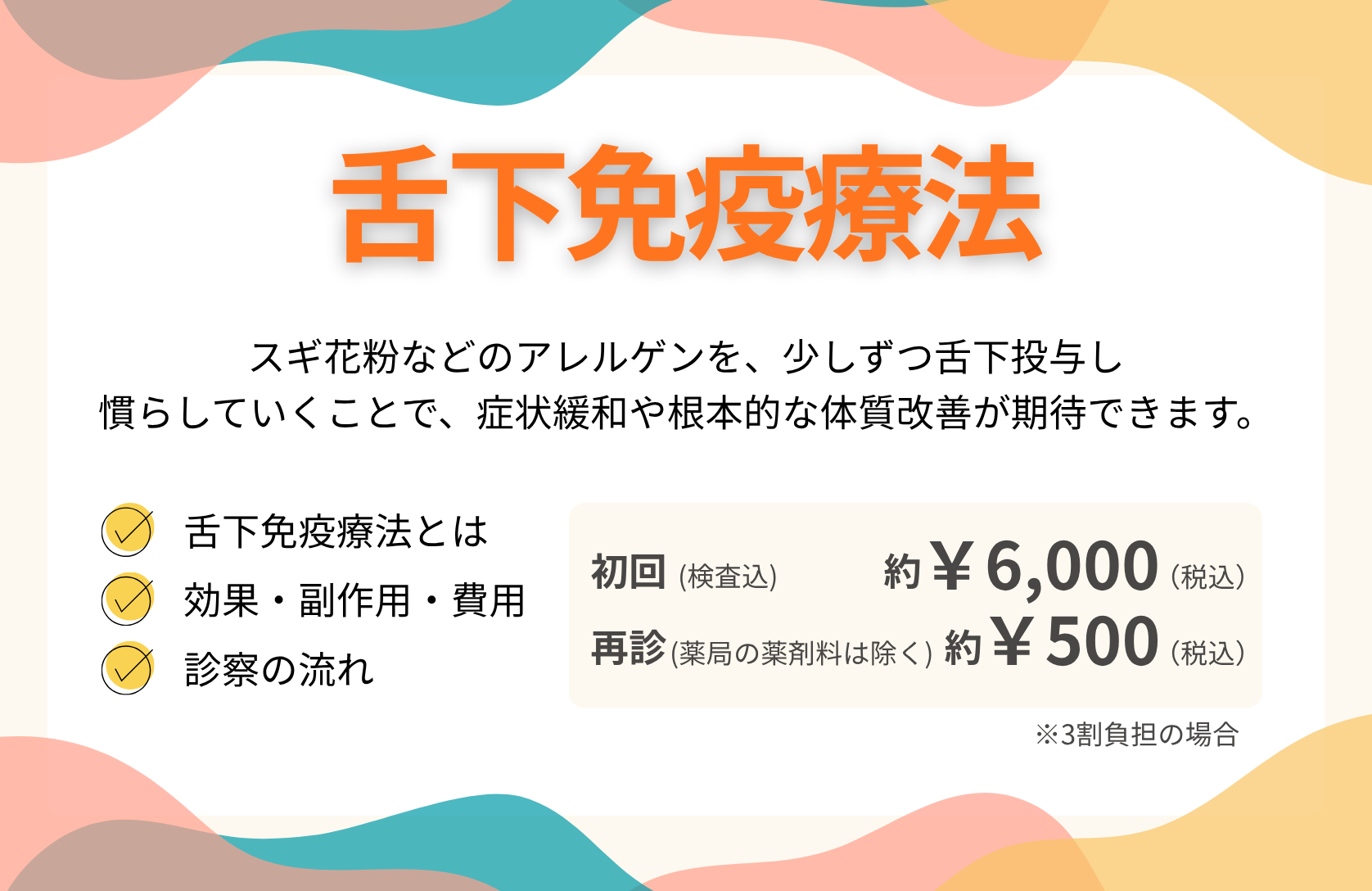
Itchy eyes, a runny nose that will not stop… Have these symptoms been continuing? They may be caused by an allergy to cedar pollen or mites.
We can provide sublingual immunotherapy, which can greatly improve allergic symptoms caused by cedar pollen and mites.
With sublingual immunotherapy, both testing and prescription can be performed under insurance coverage.
Please select the section to jump to.
Note that the prices indicated in this page are all inclusive of tax.
What is Sublingual Immunotherapy?
Sublingual immunotherapy is a form of allergen immunotherapy. By administering the allergen that causes the allergy sublingually in small amounts, the body gradually becomes accustomed to the allergen, and relief of symptoms and a fundamental improvement of the underlying allergic constitution can be expected.
Sublingual immunotherapy does not involve the pain of conventional subcutaneous immunotherapy given by subcutaneous injection, and it can be taken at home, so it places less burden on the patient.
While systemic adverse reactions such as anaphylactic shock are less frequent than with subcutaneous immunotherapy, it is a treatment that requires the patient’s understanding of the dose, how to take it and how to respond to side effects.
In Japan, sublingual immunotherapy is covered by insurance only for cedar pollen allergy and perennial allergic rhinitis caused by mite allergens. We confirm the diagnosis of whether these forms of allergic rhinitis are present, and treatment can be carried out after diagnosis.
Pollen allergy is a condition in which plant pollen causes allergic symptoms such as sneezing, a runny nose, nasal congestion and itchy eyes.
The form caused by cedar pollen is called “cedar pollen allergy”, and close to forty percent of Japanese people are said to have cedar pollen allergy.
Perennial allergic rhinitis is a condition in which allergic symptoms such as sneezing, a runny nose and nasal congestion appear regardless of the season, and about 25% of Japanese people are said to have perennial allergic rhinitis.
The main causes of perennial allergic rhinitis are known to include mites, fungi (mold), insects and pet hair, and the form caused by mites is called “mite allergic rhinitis”.
Effects of Sublingual Immunotherapy
The following effects can be expected from sublingual immunotherapy.
When treatment is carried out correctly over a long period, effects such as curing allergic symptoms or suppressing symptoms over the long term can be expected.
– Improvement of sneezing, runny nose and nasal congestion
– Improvement of watery eyes and itchy eyes
– Reduction of allergy treatment medication
– Improvement of QOL (quality of life)
Please refer to the following as a guide to how long it takes to feel the effects of treatment.
Cedar pollen allergy: from the first cedar pollen season after starting treatment
Mite allergic rhinitis: from several months after starting treatment
For either treatment, a treatment period of approximately 3 to 5 years is considered necessary.
Side Effects of Sublingual Immunotherapy
Because sublingual immunotherapy involves sublingual administration of an allergen, local or systemic allergic reactions may occur.
As minor side effects, local reactions centered on the area around the mouth, such as the following, may be seen.
– Swelling, itching, discomfort or abnormal sensation in the mouth
– Swelling of the lips
– Irritation or discomfort in the throat
– Itching of the ears, etc.
In addition, as a serious side effect, a systemic allergy (anaphylactic shock) may occur in very rare cases.
The timing at which serious allergic reactions occur has been reported as follows.
– About 30 minutes after taking the medication
– The early stage after starting the medication
– (In the case of sublingual immunotherapy for cedar pollen allergy) the period when cedar pollen is dispersing
For this reason, the first dose of sublingual immunotherapy must always be taken at our clinic, and you will stay in the clinic for 30 minutes after taking the medication.
Precautions at the Start and Treatment Duration
Here we list the practical points of taking sublingual immunotherapy and several precautions.
A diagnosis is always required before starting treatment
To receive sublingual immunotherapy, a confirmed diagnosis of cedar pollen allergy or mite allergic rhinitis is required.
Before starting treatment, we perform a serum antibody test at our clinic and confirm the diagnosis.
The medication is administered sublingually, 1 tablet once a day
After sublingual administration, do not swallow your saliva for 1 minute and keep the tablet in your mouth.
After taking it, refrain from gargling, eating and drinking for 5 minutes.
There are periods when treatment for cedar pollen allergy cannot be started
Treatment cannot be started during the period when cedar pollen is dispersing (approximately December to May, varying by region).
Treatment for mite allergic rhinitis is possible at any time throughout the year.
Monthly visits are required, and treatment takes 3 to 5 years
Sublingual immunotherapy needs to be taken continuously for 3 to 5 years.
The first dose is taken at our clinic, and from the second day onward it can be taken at home.
A visit at least once a month is required, and prescriptions are for a maximum of 30 days.
Prices
Sublingual immunotherapy can be provided under insurance coverage (it can also be provided as self-pay care, but in that case it is a ten-tenths co-payment).
The fees required for testing and prescription are as follows.
| Item | Price thirty-percent co-payment (JPY) |
|---|---|
| Initial Test + Consultation | Approx. 6,000 |
| Initial/Continuing Prescription | Approx. 500 (excludes pharmacy payment*) |
*The pharmacy price is approximately 1,500-2,000 JPY/month (with thirty-percent co-payment).
Consultation Flow
For sublingual immunotherapy, testing and treatment are available through in-person consultation only.
Consultation and Testing After Your Visit
Please come to the clinic at your appointment time on the day. We will give you a number at reception and call you by that number for testing, payment and so on.
Based on your medical questionnaire, we will ask in detail about the degree of your symptoms, and if you wish to receive sublingual immunotherapy, we will perform a blood test.
Explanation of Results and Decision on the Treatment Start Date
After the blood test, you will see the doctor again, and we will determine whether sublingual immunotherapy is indicated.
If it is indicated, we will book your next outpatient appointment and give you a prescription.
You will need to exchange the prescription for the medication yourself at your nearest pharmacy within 4 days, including the date of issue.
You will need to check yourself whether the pharmacy you prefer has the medication for sublingual immunotherapy in stock.
We can also introduce you to pharmacies near our clinic that handle it, so please speak to our staff.
First Treatment
Please come to the clinic at the date and time you booked previously, and take the first dose at the clinic.
You will stay in the clinic for 30 minutes, and after we check that there are no problems, you may go home.
Continued Treatment
Every month, we will provide continued prescriptions while checking your symptoms and whether any allergic reactions have occurred.
Treatment takes approximately 3 to 5 years.
For Those with Severe Cedar Pollen Allergy
Since 2020, it has become possible to provide treatment in which the anti-IgE antibody omalizumab (Xolair®) is given by subcutaneous injection from February to May for severe and most severe cedar pollen allergy.
For those whose symptoms from cedar pollen allergy are very strong, as described below, we consider this a treatment well worth considering.
– Those with very strong rhinitis symptoms from cedar pollen allergy, such as sneezing, a runny nose and nasal congestion
– Those who are troubled by cedar pollen allergy all day long, with symptoms that do not subside even with medication taken orally, nasal sprays, etc.
– Those who experience strong drowsiness from antihistamines and therefore cannot change to or increase the dose of a stronger medication
– Those with severe or most severe cedar pollen allergy who visited a medical institution during the previous cedar pollen season and whose symptoms did not improve even with treatment using a steroid nasal spray and an antihistamine taken orally. Also, those who can present the details of that prescription (such as a medication record book or medication record app).
*Those who were treated in the previous season with over-the-counter nasal sprays or medication taken orally cannot receive Xolair treatment this season.
– Those who have received standard treatment this year as well (an antihistamine taken orally plus a steroid nasal spray) for 1 week or more but for whom the effect was insufficient.
– Those aged 12 or older, with a body weight within the range of 20 to 150 kg, a total serum IgE concentration against cedar pollen of 30 to 1,500 IU/ml, and specific IgE antibodies against cedar pollen antigen (blood test) in the range of class 3 or higher.
The price is only the drug price of Xolair, and for those with a thirty-percent co-payment the out-of-pocket amount is approximately 4,500 JPY to 70,000 JPY per month.
Because the dose differs from person to person (it is package based on body weight and total blood IgE concentration), the out-of-pocket amount varies between individuals.
In addition, there are prices for the visit and blood tests, and the prescription price for the antihistamine that needs to be taken continuously at the same time.
For details, please see the pharmaceutical company’s site below.
In order to have Xolair prescribed under insurance coverage, 3 visits are required up to and including the first dose.
During those 3 visits, it is necessary to confirm (1) the diagnosis of severe pollen allergy, (2) non-specific/specific IgE antibody testing and (3) that existing treatment has been insufficiently effective.
Consultation and Testing After Your Visit on the Day
Please come to the clinic at your appointment time on the day. We will give you a number at reception and call you by that number for testing, payment and so on.
Through a medical interview, we will diagnose whether you have severe or most severe cedar pollen allergy. Please be sure to bring a medication record book showing the details of your prescriptions during the previous cedar pollen season.
We will perform a blood test and prescribe an antihistamine taken orally, a steroid nasal spray and so on from our clinic for 1 week or more.
Explanation of Results and Testing
If we determine that the effect of the medication taken orally and so on is insufficient, Xolair treatment is indicated.
Based on the blood test results and body weight, we determine the dose of Xolair and the dosing interval (every 2 weeks or every 4 weeks), and carry out a blood test after prescribing.
We will decide the date of Xolair administration.
First Treatment
Please come to the clinic at the date and time you booked previously, and we will carry out the first dose.
Continued Treatment
Xolair will be administered again 2 to 4 weeks after the first dose. Treatment with Xolair is only possible from February to May, when large amounts of cedar pollen are dispersing.
We also provide testing and treatment for STIs, vaccine administration of various types (including for those traveling overseas) and consultations regarding gender. For details, please see the page below.